
Wire insert taps
When working with wire thread inserts you will need to use a wire insert tap, which are slightly oversize in order to suit the wire insert and therefore differ dimensionally from standard taps. Manufactured from High Speed Steel (HSS and HSSE), our wire insert taps are available in a variety of hand and machine types, as well as more specialised types.
Our wire insert taps are designed to generate wire thread insert tapped holes in a variety of ferrous and non-ferrous materials. They produce close tolerance tapped holes in accordance with all internationally recognised wire insert standards, and are compatible with other wire insert manufacturers’ products.
The success of any tapping operation depends on many factors, including but not limited to:
- Tapping speed
- Depth of cut
- Type of material being cut
- Condition of the material being cut
- Type of coolant and/or lubricant
- Type of tapping head
Our recommended sizes for diameter are charted in our technical data brochure
Hand Taps
Our hand taps have parallel flutes and though primarily used for hand tapping, due to recently improved manufacturing techniques, they may also be suitable for machine tapping.

Finishing
Also known as intermediate or second lead taps, our finishing taps have 3-5 taper lead threads that provide a tapped hole with a full diameter thread. Generally used for through holes, this is the most commonly used tap, as in many cases it can be used without the need for roughing and bottoming taps.

Roughing
Also known as taper or first lead taps, our roughing taps have up to 8 tapered threads, which give a gradual cutting action that prepares a tapped hole marginally undersize in diameter prior to the subsequent use of finishing and/or bottoming taps. When used in this way, finishing and bottoming taps have a longer cutting life.
Roughing taps are recommended for use with larger diameter sizes, coarse pitch threads, and tough materials.

Bottoming
Also known as plug taps, our bottoming taps have 1-1.5 lead threads that will cut a full diameter thread to the bottom of a blind hole. They are typically used following the use of a roughing or finishing tap.
Machine taps
Our machine taps are specially designed for use in high volume production.
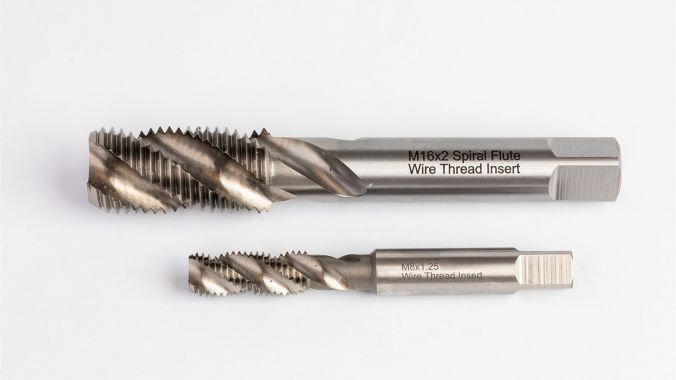
Spiral flute
The spiral flute tap has a bottoming chamfer lead with helical flutes ground in the same direction as the thread. This directs the swarf back out of the tapped hole, making our spiral flute taps particularly suitable for use in blind holes or in materials that produce a continuous chip.

Spiral point
A spiral point is ground into the lead threads at an angle to the tap axis, which produces a tap with initial left hand flutes that have a progressive cutting rake towards the point of the tap. This allows it to tap precise holes in a single pass at very high peripheral speeds.
The spiral point is to be used in through holes, as the swarf produced is pushed ahead of the tap and falls free as it emerges through the hole, eliminating hazards caused by chips accumulating in the flutes during cutting.
Special taps
We also stock wire insert taps needed for more specialised purposes.

Pilot nose tap
Simple and easy to use, our uniquely designed pilot nose 2-stage reamer taps have been developed for the repair of damaged sparking plug threads without the need for additional drilling.
For use in through holes, the tap uses the original thread to guide it, meaning that in one single operation the new wire insert thread will be concentrically aligned to the original thread. The tap has reamer faces behind the pilot thread that cut the hole to size prior to tapping of the wire insert thread form.

Cold forming taps
Also known as fluteless or roll taps, our cold forming taps have no cutting edges or flutes, which provides a number of benefits:
- No point of weakness in the tapped hole as the grain structure is unbroken, resulting in a stronger thread so that the normally accepted 75% thread depth produced with conventional thread cutting taps can be reduced to 60% depth, without any loss of strength
- No swarf is produced, making cold forming taps ideal for use in blind holes as it eliminates associated chip removal problem.
- Having no cutting edges or flutes makes cold forming taps stronger than conventional thread cutting taps, and when used correctly, they suffer minimal breaking and have a longer life
- Can be used at faster speeds than conventional thread cutting taps, with higher than normal tapping speeds being found to be advantageous.
However, as the taps cold form wire insert internal threads rather than cut them, cold forming taps can only be used in ductile materials such as aluminium, brass, magnesium, zinc, etc
COLD FORMING NOTES:
- Better results have been achieved using lubricating oils rather than conventional cutting oils
- The displacement of metal during cold forming has a tendency to upset the metal on the work piece surface, and counter-sinking of the drilled hole is therefore recommended to eliminate interference between mating parts
- Cold forming taps are not recommended where the wall thickness is less than 70% of the nominal tap diameter
- Since the tapping drill size is based on metal deformation, the recommended tapping drill sizes for conventional thread cutting taps do not apply to cold forming taps.


